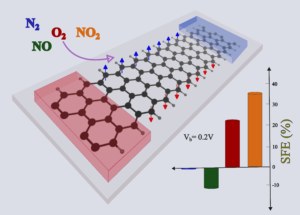
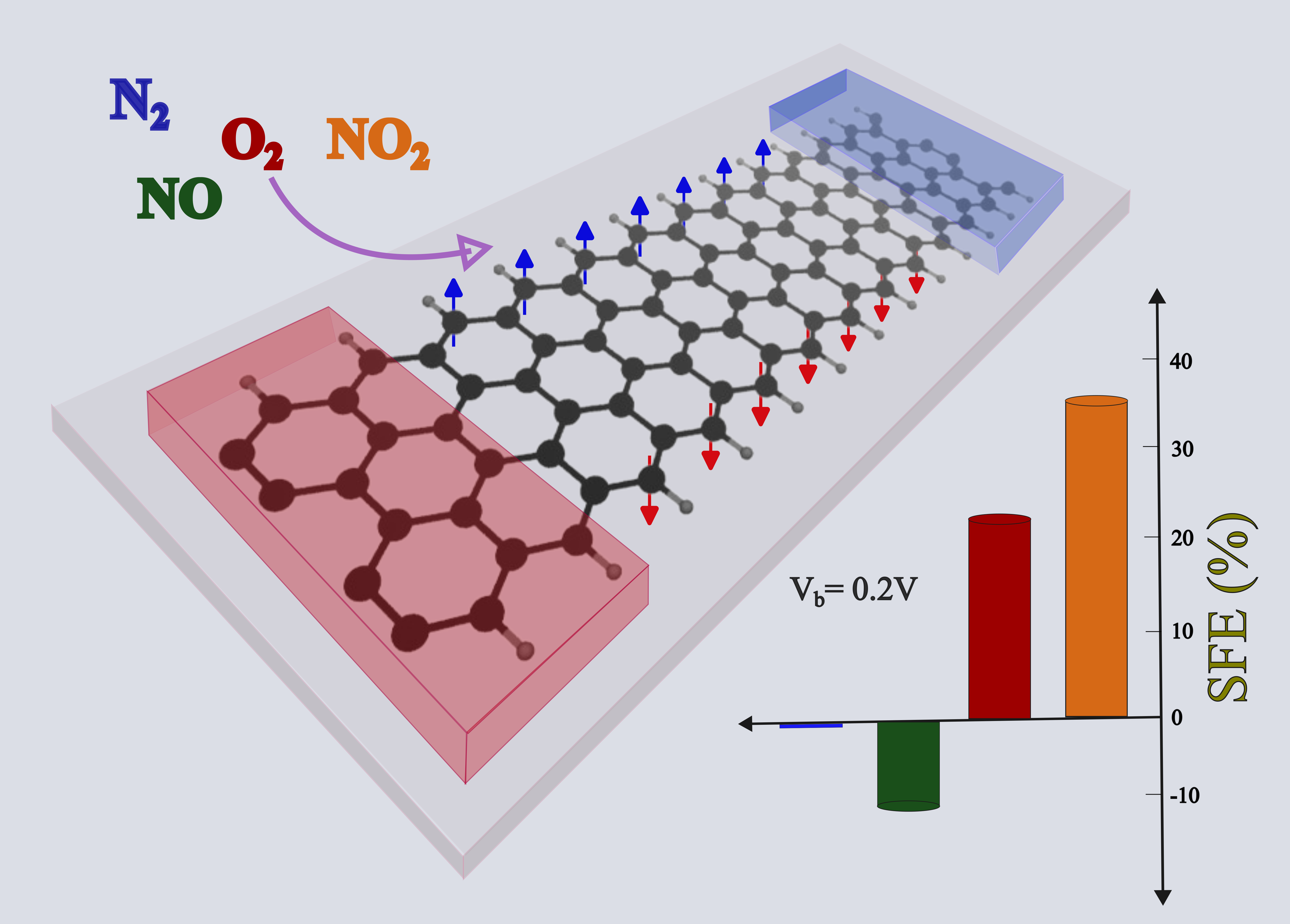
Quantum spin sensors leverage spin states for highly sensitive environmental detection. While NV centres in diamond are established, graphene-based zig-zag graphene nanoribbons (ZGNRs) offer a tuneable, scalable alternative. This first-principle based computational study investigates ZGNRs for sensing: open-shell paramagnetic molecules chemisorb on ZGNR edges, disrupting spin symmetry and inducing spin-polarized transmission via quantum interference. Resulting unique spin current patterns enable selective molecular recognition. This research provides fundamental insights into molecule-graphene interactions, paving the way for innovative, highly sensitive graphene quantum spin sensors with potential advantages in fabrication and integration over traditional NV centres.
Bajaj, A.; Ali, S.; Khurana, R. and Ali, M.E.;"Quantum Spin Transport Through Blatter’s Diradicals and Triradicals" , J. Phys. Chem. B. , 2025 , 129 , 4252-4264.
Quantum Spin Transport Through Blatter’s Diradicals and Triradicals
Authors:
Bajaj, A.; Ali, S.; Khurana, R. and Ali, M.E.
Abstract:
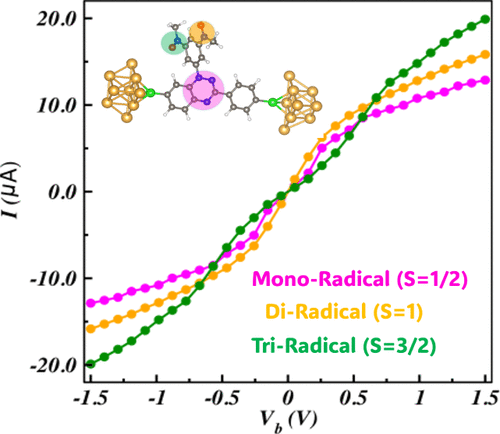
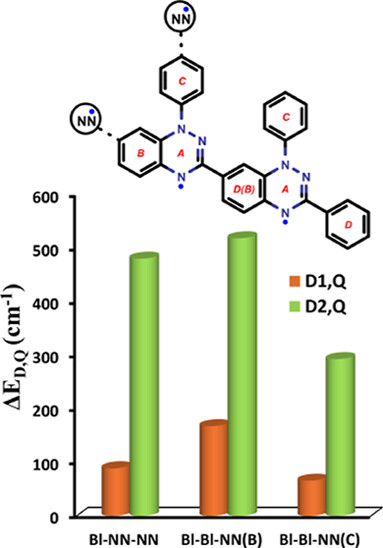
A single unpaired electron in an organic molecule residing in the singly occupied molecular orbital (SOMO) renders it an organic radical. It incorporates exchange splitting in the frontier occupied and unoccupied orbitals, separating the α- and β-orbitals. This fact enormously impacts the electron transport properties in organic radicals by promoting spin-polarized current and significantly enhancing conductance compared to their closed-shell counterparts. Exploring these phenomena, several monoradicals have been investigated through molecular spintronic experiments and theories. In this work, we addressed the impact of an increasing number of radical centers on the transport properties of multiradical molecular species by considering di- and triradicals based on a stable Blatter’s radical. With an increasing number of radical centers, the number of SOMOs increases. Does the increased number of frontier SOMOs provide larger exchange splitting and better transport properties? Here, we observed that the spatial distributions of SOMOs and their coupling with electrodes play a decisive role compared with the presence of multiple unpaired electrons in the molecular systems.
Ali, S. and Ali, M.E.;"Quantum spin sensors for open-shell molecules" , J. Mater. Chem. C. , 2025 , 13 , 7760-7771.
Quantum spin sensors for open-shell molecules
Authors:
Ali, S. and Ali, M.E.
Publication Details: J. Mater. Chem. C. , 2025 , 13 , 7760-7771
Abstract:
Zigzag graphene nanoribbons (ZGNRs) exhibit symmetric, but opposite spin distributions on their edges, making them susceptible to perturbations due to molecular adsorption. This study investigates the impact of the adsorption of closed-shell (e.g. N2, CO, CO2) and open-shell paramagnetic (e.g. O2, NO, NO2) molecules on the spin-polarized quantum transport properties of zigzag graphene nanoribbons using density functional theory and nonequilibrium Green's function (NEGF-DFT) methods. We found that closed-shell molecules physisorbed on graphene nanoribbons, while open-shell molecules chemisorbed strongly at the edges. This chemisorption disrupts the symmetric spin distribution, leading to spin-polarized transmission. The underlying mechanism for spin-polarized transmission in open-shell molecule adsorption cases is the quantum interference between the localized and delocalized hybridized states of molecule adsorbed graphene nanoribbons. The analysis of bond current, the current between a pair of two atoms, shows that physisorbed closed-shell molecules act as a scattering center, which reduces the current through graphene nanoribbons. We showed that the interaction of open-shell molecules with the graphene nanoribbons depends on the electronic properties of adsorbed molecules. Thus, a variation in the destructive quantum interference pattern is observed for different open-shell molecules resulting in different spin currents. This phenomenon can be used for molecular recognition of open-shell paramagnetic species, providing avenues for quantum spin sensor technology.
Ali, S. and Ali, M. E.;"Broken edge spin symmetry induces a spin-polarized current in graphene nanoribbon" , J. Phys. D: Appl. Phys. , 2024 , 57 , 215001.
Broken edge spin symmetry induces a spin-polarized current in graphene nanoribbon
Abstract:
Zigzag graphene nanoribbons (ZGNRs) are known to possess spin moments at the hydrogen-terminated edge carbon atoms; thus, spin-polarized electron transmission is expected, while the current is longitudinally passed through the ZGNRs. However, in pristine ZGNRs, spin-polarized transmission is not observed due to symmetric anti-parallel distributions of the spin densities between the edges. Here, the hypothesis is that any physical or chemical process that breaks such anti-parallel spin symmetry can induce spin-polarized transmission in ZGNRs.
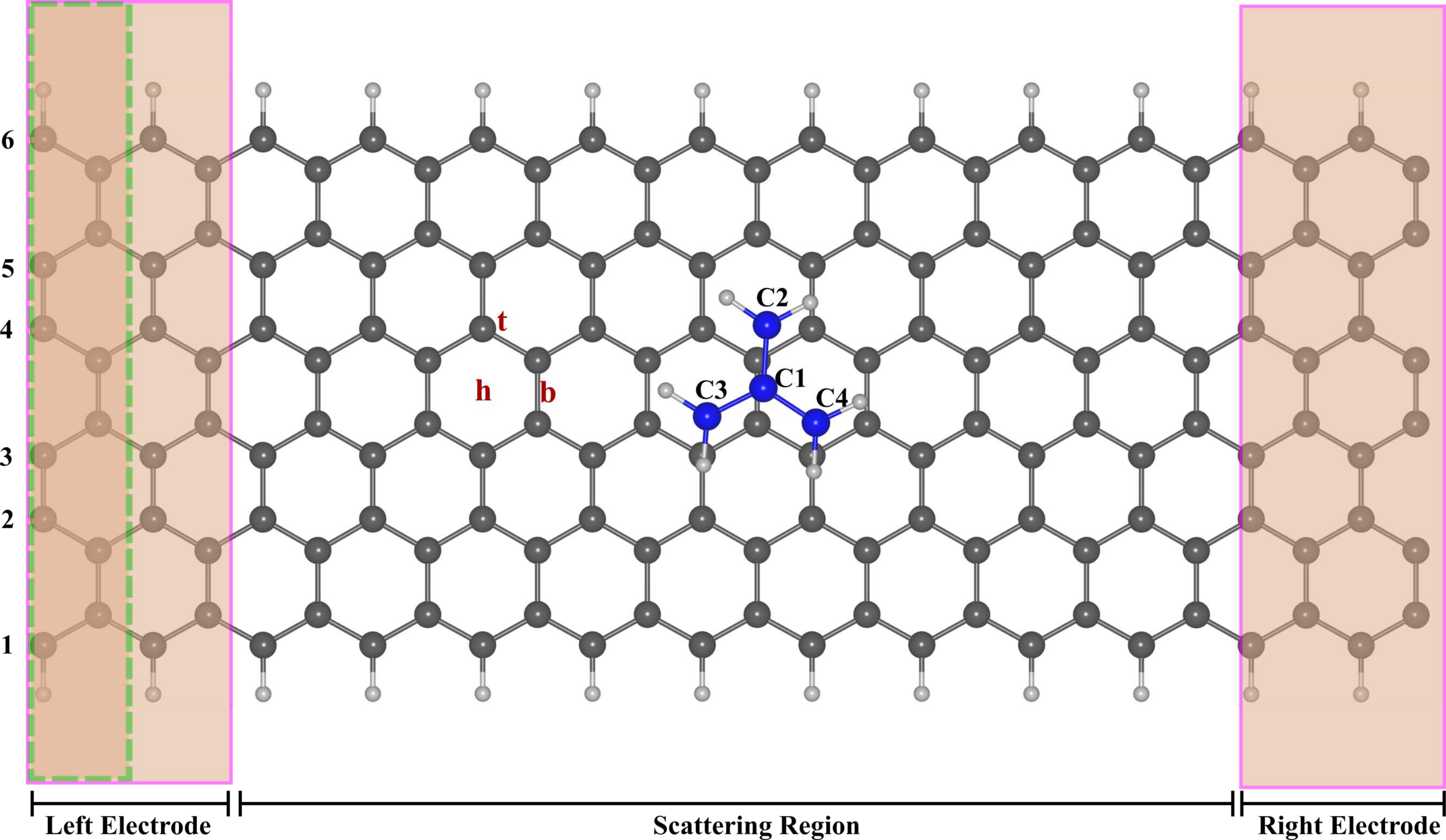
In this work, we have established this proof-of-concept by depositing the trimethylenemethane (TMM) radical on 6ZGNRH and investigating the quantum transport properties by employing
density functional theory in conjunction with the nonequilibrium Green’s function method. Although TMM has a high magnetic moment (2µB), it does not induce magnetization in 6ZGNRH when TMM is physisorbed. However, during the chemisorption of TMM, it forms the π − π bond with the 6ZGNRH in a particular geometric configuration, where the pz orbitals of carbon atoms of TMM have maximum overlap with the pz orbitals of carbon atoms of 6ZGNRH. The chemisorption of TMM transfers the spin moment to 6ZGNRH, which breaks the edge spin symmetry of pristine 6ZGNRH. The adsorption of the TMM radical results in transmission dips in the transmission spectra due to interference between localized states of TMM and 6ZGNRH states. This induces spin-polarized transmission with 60% spin-filtering efficiency at zero bias, which can further be enhanced up to 92% by applying a bias voltage of 1.0 V.
Abstract:
Robust organic triradicals with high-spin quartet ground states provide promising applications in molecular magnets, spintronics, etc. In this context, a triradical based on Blatter’s radical has been synthesized recently, having two low-lying non-degenerate doublet states with a quartet ground state. The traditional broken-symmetry (BS)-DFT computed doublet–quartet energy gaps are reported to be somewhat overestimated in comparison to the experimentally observed values. In this work, we have employed different ab initio methods on this prototypical system to obtain more accurate doublet–quartet energy gaps for this triradical. The spin-constraint broken-symmetry (CBS)-DFT method has been used to reduce the overestimation of energy gaps from BS-DFT. To address the issues of spin-contamination and the multireference nature of low-spin states affecting the DFT methods, we have computed the energy gaps using appropriately state-averaged CASSCF and NEVPT2 computations. Using a series of active spaces, our calculations are shown to provide quite accurate values in concordance with the experimentally observed results. Furthermore, we have proposed and modeled another two triradicals based on Blatter’s radical, which are of interest for experimental synthesis and characterization. Our computations show that all these triradicals also have a quartet ground state with a similar energy difference between the excited doublet states.
Abstract:
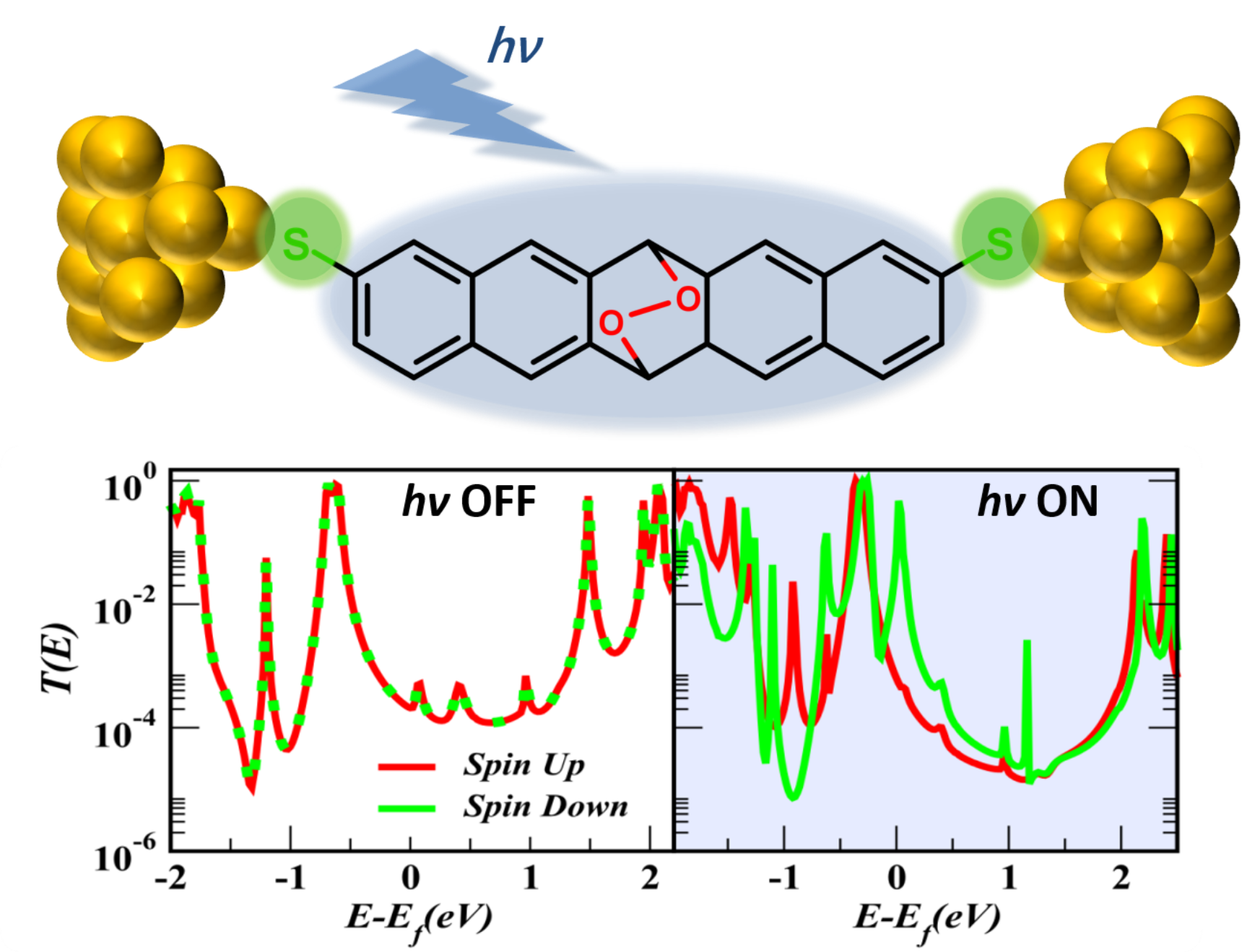
The development of stimuli responsive systems that can switch between two distinct spin states under the application of an external stimulus has always remained an elusive challenge. Here, we report a stimuli-based spin filter by utilizing a photo-responsive endoperoxide (EPO) based single molecule device. Photo-irradiation of EPO triggers the homolytic cleavage of the peroxide O–O bond generating a diradical intermediate centered on two O-atoms which facilitates high spin filtering efficiency when placed between gold electrodes. The broken conjugated scenario due to the peroxide bridge of EPO hinders the propagation of de Broglie waves across the molecular skeleton. On the other hand, the diradical intermediate of EPO yields high conductance for one of the spin configurations. The transmission characteristics of various photoproducts along the photochemical reaction pathway of EPO are also investigated using density functional theory in combination with the non-equilibrium Green's function (NEGF-DFT) technique. We demonstrate the key role played by quantum interference (QI) effects in the dramatic modulation of conductance arising due to different degrees of conjugation along the reaction pathway of EPO.
We are working at the Institute of Nano Science and Technology Mohali, one of the leading research institutes in India in the field of Nano Science. INST is located in Chandigarh, one of the major cities of India.